Organic Modern Interior Design: The Complete 2026 Guide to Nature-Inspired Rooms
Master organic modern design in 2026: warm earthy palettes, raw wood & stone textures, room-by-room styling rules, and how it differs from Japandi.
 Easy Room AI Team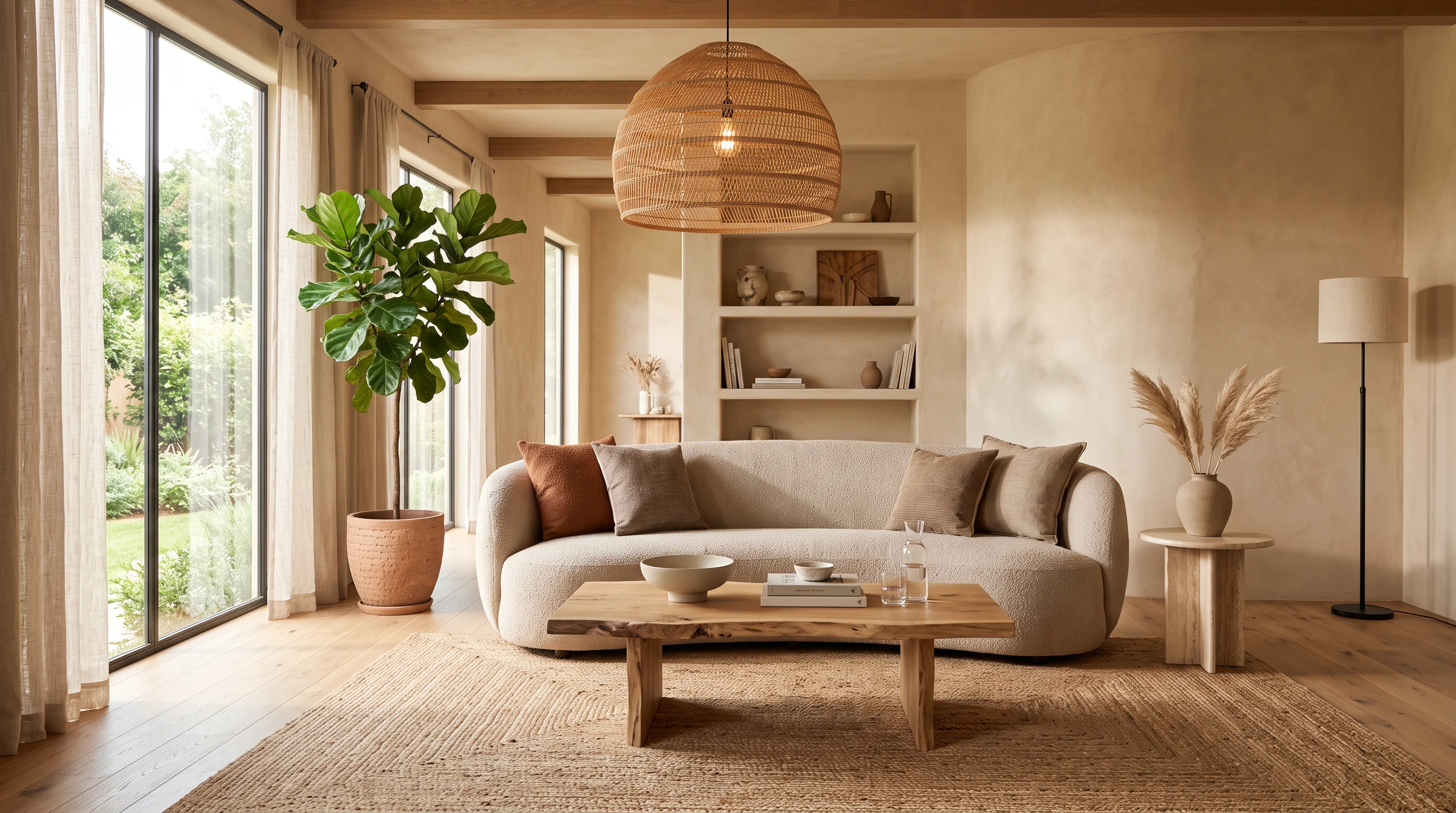
Gray-on-gray minimalism has a replacement, and the data backs it up. In the NKBA 2026 Kitchen Trends Report — based on a survey of 634 industry professionals — organic and natural design came in at 58% popularity, right behind transitional (72%) and contemporary (60%). Meanwhile Houzz's 2026 Summer Trends Report shows search spikes for the materials that make organic modern tick: sandstone up 257%, linen wallpaper up 104%, and seagrass wallpaper up 94%.
Organic modern is not a trend you have to wait for — it is already the mainstream.
In this guide you will learn exactly what organic modern is, how it differs from warm minimalism and Japandi, and how to apply it room by room with a clear color palette, material checklist, and furniture strategy.
What Is Organic Modern Interior Design?
Organic modern merges clean, modern lines with raw natural materials and soft, sculptural forms. The result is a room that feels edited but never cold.
Three characteristics set it apart:
-
Natural materials in starring roles. Wood, stone, linen, ceramic, and leather are not accents — they are the room. NKBA data confirms the shift: wood-grain cabinetry overtook painted cabinets at 59%, with white oak the most popular species at 51%.
-
Curved, sculptural silhouettes. Rounded sofas, arched doorways, and kidney-shaped coffee tables replace the sharp angles of conventional modernism. Houzz reports that searches for curved peninsulas and islands rose 123% and 61% respectively.
-
Earthy, warm-neutral palette. Sand, oatmeal, taupe, and cream form the base; rust, chocolate brown, and olive provide depth. Cool grays are out. Houzz's data shows rust colors up 178%, chocolate brown up 153%, and mushroom up 69%.
As NKBA Director of Research Tricia Zach summarized at KBIS 2026: "Seamless, organic, earthy design is the aesthetic expression of calm, balance, and connection to nature."
Organic Modern vs Warm Minimalism vs Japandi
All three are warm-palette, natural-material styles — and they often get confused. Here is where they split:
| Organic Modern | Warm Minimalism | Japandi | |
|---|---|---|---|
| Origin | California / Australian resort | Scandinavian minimalism + warm palette | Japanese wabi-sabi + Scandinavian function |
| Form language | Sculptural curves, fluid shapes | Clean straight lines, subtle warmth | Asymmetrical, deliberately imperfect |
| Material focus | Raw wood, stone, leather, linen | Wood + bouclé + plaster | Dark-stained wood, ceramics, paper |
| Color range | Sand to rust, warm mid-tones | Cream to light taupe, tight neutrals | Muted neutrals + deep charcoal or black |
| Decor density | Medium — curated objects, greenery | Low — restrained, negative space | Low to medium — one statement per zone |
| Key texture | Heavy grain, rough stone, thick linen | Smooth plaster, soft bouclé | Hand-thrown pottery, woven bamboo |
The rule of thumb: if the room feels like a beachside architect's home with sculptural furniture and visible grain, it is organic modern. If it feels like a calm, cream-toned apartment with plaster walls, it is warm minimalism. If it feels like a tea-house crossed with a Scandinavian cabin, it is Japandi.
All three interlink beautifully — and you can layer elements from each in the same home.
Preview Organic Modern in Your Space
Upload a photo of your space to test Organic Modern instantly with AI — 100% free.
Supports JPG, PNG, WebP up to 10MB
The Organic Modern Color Palette
The palette works in three layers, and getting the ratio right is what separates a cohesive room from a muddy one.
Base layer (70% of surfaces)
Walls, large furniture, and floors. Choose one warm neutral and stay in its tonal family:
- Sand / Oat: Sherwin-Williams Accessible Beige (SW 7036), Benjamin Moore White Sand (OC-10)
- Warm cream: Sherwin-Williams Creamy (SW 7012), Benjamin Moore Simply White (OC-17)
- Warm taupe: Sherwin-Williams Balanced Beige (SW 7037), Benjamin Moore Pale Oak (OC-20)
Grounding layer (20%)
Accent furniture, rugs, and natural materials. These add depth without competing:
- Rust / Terracotta: echoes terracotta living room ideas — pair with linen and stone
- Chocolate brown: 1stDibs' 2026 survey names it the top trending color at 33%
- Olive / Sage: extends the nature connection without going too green — see our guide on sage green kitchens
- Mushroom: the neutral that bridges warm and cool, up 69% on Houzz
Anchor layer (10%)
Small but critical. Thin lines of matte black iron — light fixtures, shelf brackets, door handles — give the soft palette definition without adding cold reflections. Avoid chrome and polished nickel; powder-coated black is the signature organic-modern metal.
Materials That Define the Look
Organic modern is a tactile style. If a guest cannot resist touching the coffee table or running a hand along the wall, you have nailed it.
Wood: White oak and ash dominate. Look for pieces with visible grain rather than lacquered finishes. NKBA puts white oak at 51% popularity among designers for a reason — it is warm without being rustic.
Stone: Sandstone, travertine, and limestone in honed or tumbled finishes. Houzz's 257% surge in sandstone searches reflects the desire for soft, matte surfaces over polished marble.
Plaster and lime wash: Walls treated with lime wash or Venetian plaster add the cloud-like tonal variation that flat paint cannot. They are the single most impactful upgrade for an organic-modern room.
Linen and bouclé: Linen for curtains, slipcovers, and bedding; bouclé for accent chairs and sofas. Both read relaxed and lived-in, which is the point.
Ceramic and stoneware: Unglazed, hand-thrown vessels. Asymmetry is an asset. See our deeper dive on textured walls for more inspiration.
Organic Modern Living Room Ideas
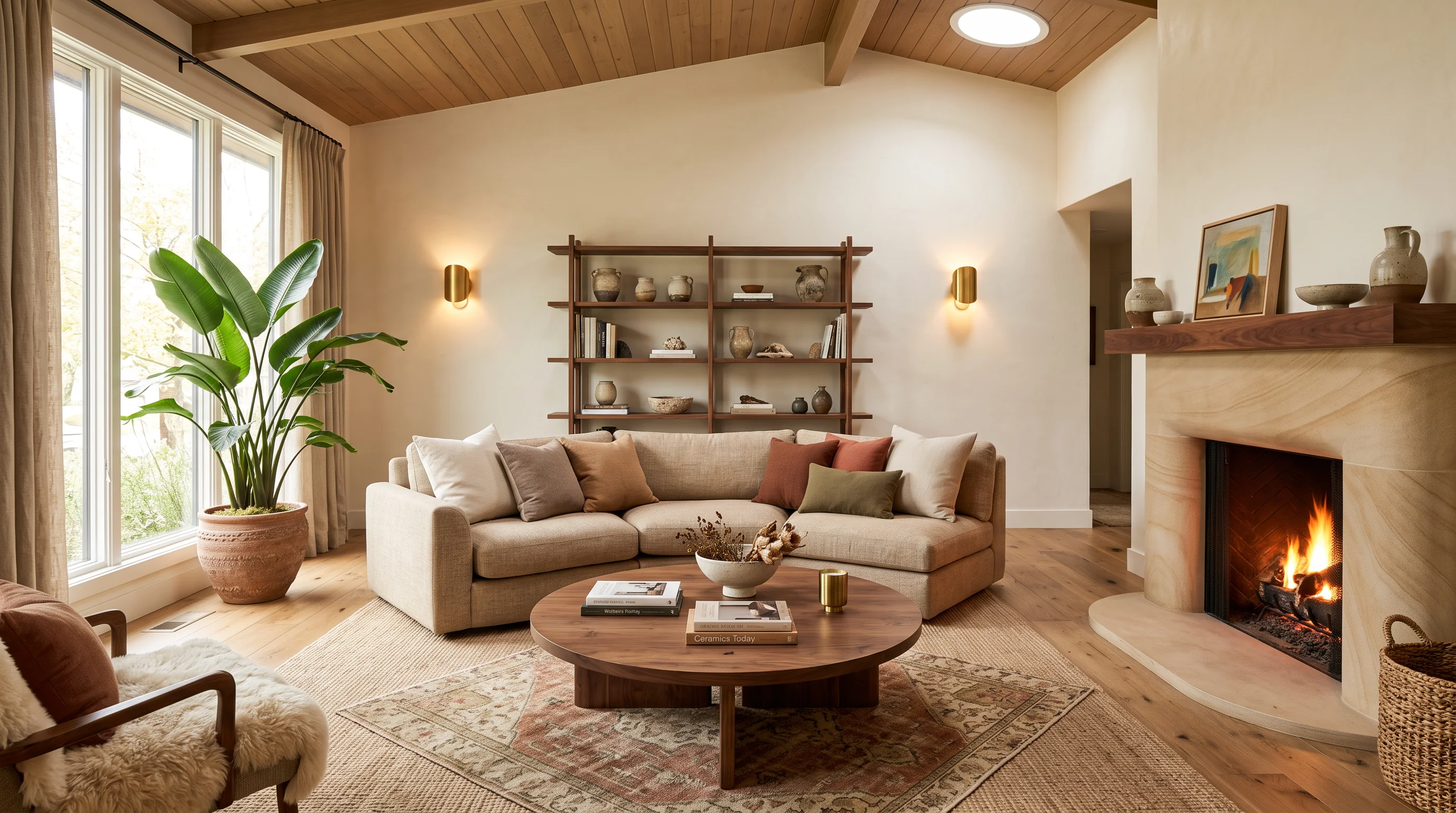
The living room is where organic modern shines hardest. Start with these moves:
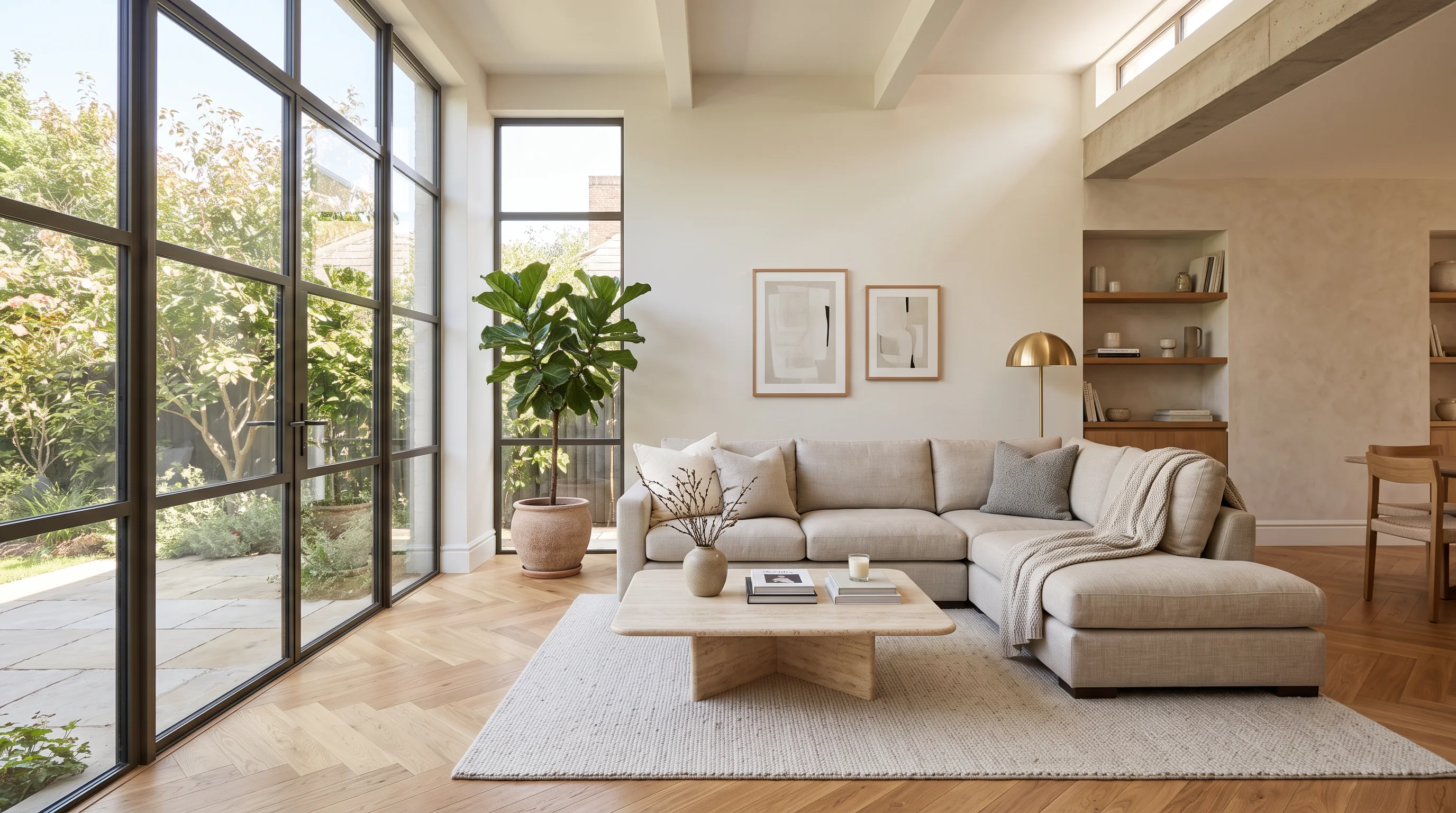
Anchor with a curved sofa. A rounded sofa in oatmeal bouclé or warm linen immediately sets the tone. Position it away from the wall to create flow — organic modern rooms avoid the "furniture against the wall" layout.
Layer rugs. A large jute or sisal base rug topped with a smaller vintage or woven accent rug adds visual depth and texture underfoot. This layered approach echoes the style's emphasis on collected, not catalog, spaces.
Choose a sculptural coffee table. An irregular-edge oak slab, a travertine drum, or a rounded walnut piece. The table is a focal point, not an afterthought.
Let greenery do the decorating. One or two large-scale plants — a fiddle-leaf fig, an olive tree, or a bird of paradise — deliver the biophilic warmth that defines the style. Skip the shelf of tiny succulents; organic modern favors scale.
Lighting. Replace overhead fixtures with a mix of warm-toned sconces (2700K–3000K), a sculptural floor lamp, and one statement pendant in rattan, paper, or matte ceramic.
Organic Modern Bedroom Ideas
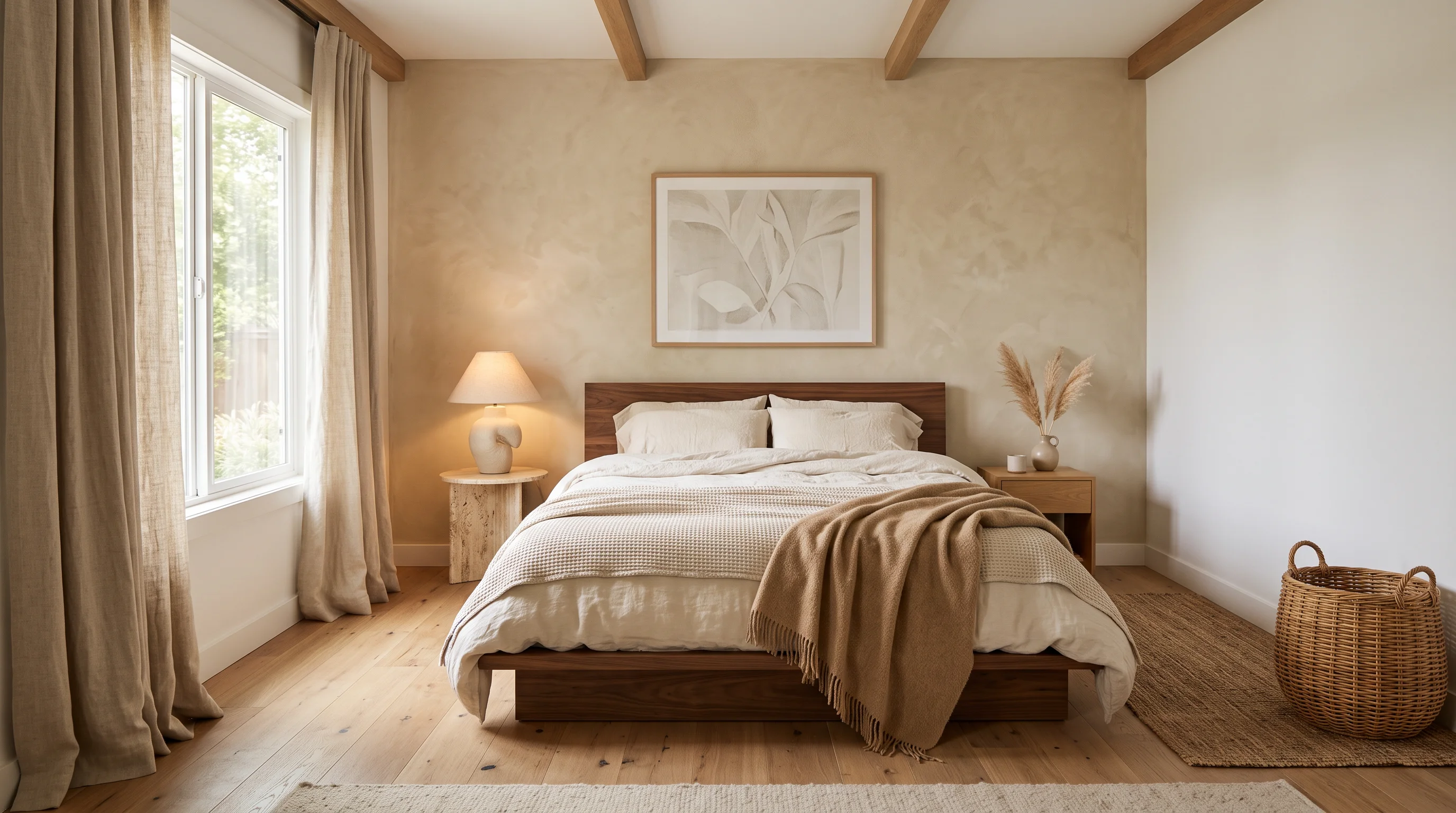
The bedroom should feel like a sanctuary. That means fewer pieces, richer textures.
The bed. A low-profile platform bed in warm oak or walnut. Pair it with a linen or cane headboard to keep the look light. If you want a reference, think about the warm cozy minimalist bedroom approach — but with more visible grain and a slightly fuller decor layer.
Bedding stack. Layer linen sheets, a waffle-knit blanket, and a chunky wool or cotton throw. Stick to the same tonal family (cream to camel) and let texture do the differentiation.
Nightstands. Asymmetry works here. Mismatched materials — one in stone, one in wood — feel collected rather than showroom-staged.
Walls. A lime-washed or micro-cement accent wall behind the bed adds depth without a gallery wall's visual noise. Keep the remaining walls in a warm white.
Organic Modern Kitchen Ideas
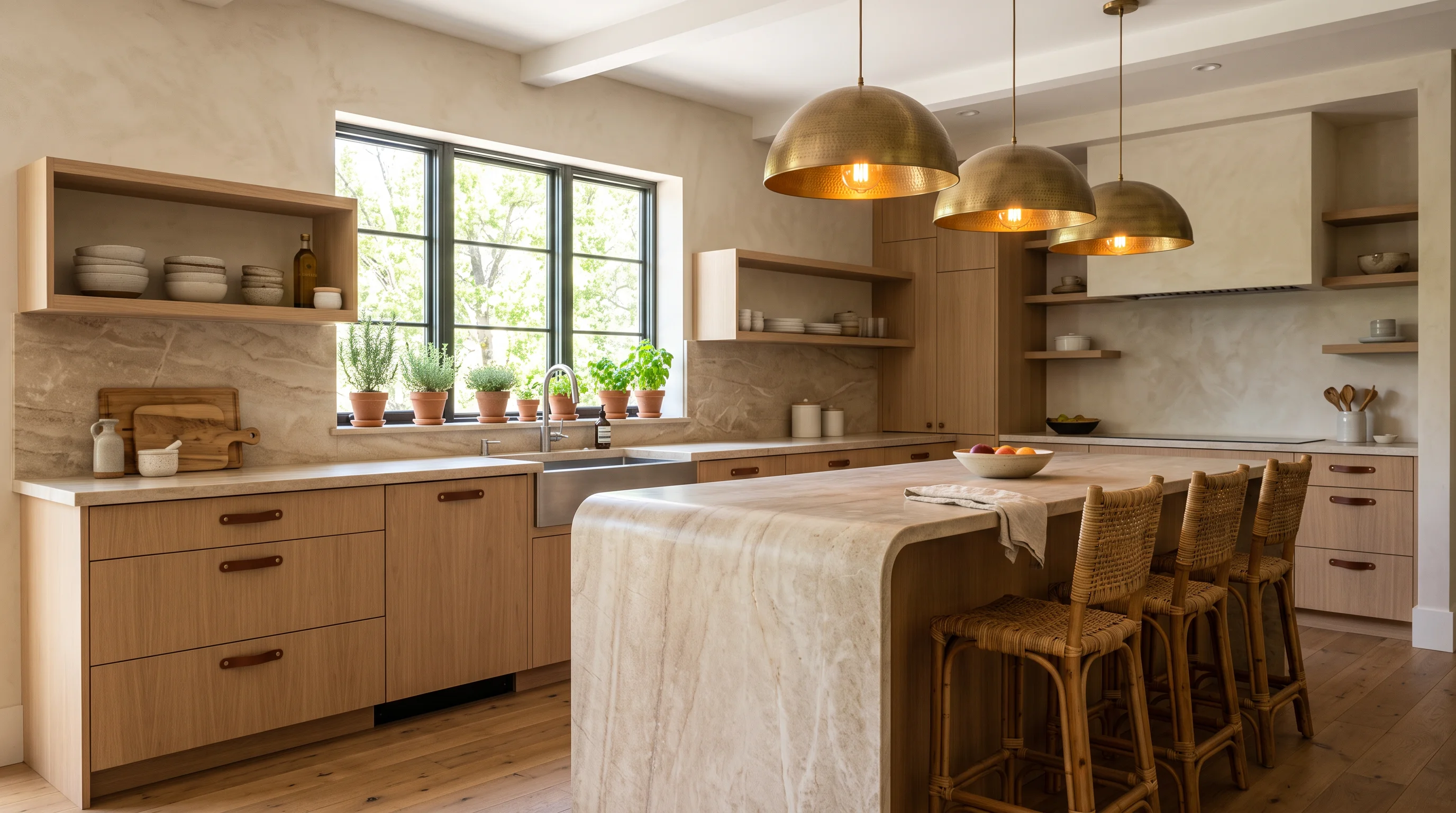
The kitchen is where organic modern has the strongest industry backing. NKBA's 11 core 2026 themes include "organic and earthy aesthetics," and the material data confirms it.
Cabinetry. White oak slab-front cabinets are the move. Flat panels with minimal hardware (leather pulls or recessed finger grooves) read modern; the visible grain reads organic. This is the intersection.
Countertops. Natural quartzite (62% of designers, per NKBA) and honed granite are overtaking the polished-quartz look. Travertine and limestone are rising choices for lower-traffic prep areas.
Backsplash. Consider limewash or micro-cement as a backsplash rather than tile — it creates continuity with the walls. If you want tile, handmade zellige in a warm neutral extends the organic feel.
Island. Curved or waterfall-edge islands soften the kitchen's geometry. Add open shelving on one end for ceramics and cookbooks to avoid the "all-closed" sterility.
For more kitchen color direction, see our guides on kitchen cabinet color trends 2026 and muted kitchen colors.
Organic Modern Bathroom Ideas
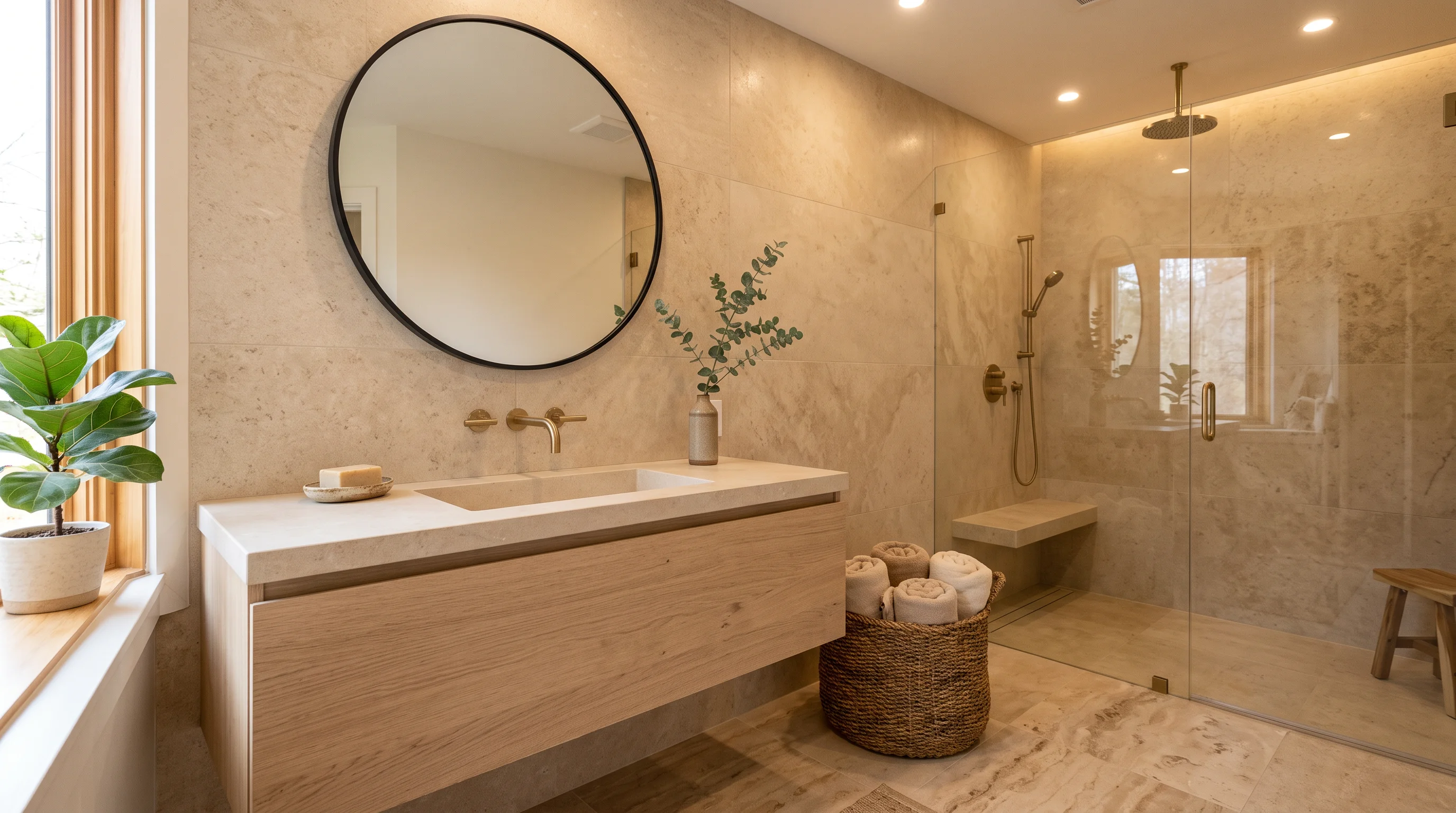
NKBA's research calls the 2026 bathroom "calm, restorative, and easy." Organic modern delivers exactly that.
Tile. Large-format limestone or travertine on floors and walls for visual continuity. Minimal grout lines keep the space feeling seamless.
Vanity. A floating oak vanity with an integrated stone basin. The combination of wood warmth and stone weight is quintessential organic modern.
Fixtures. Brushed brass or matte black — both pair with warm stone. Avoid chrome, which pulls the palette cold.
Accents. Woven baskets for storage, a hand-thrown ceramic soap dish, and a linen hand towel. Small details that visitors actually touch reinforce the tactile principle.
For a deeper dive into spa-like bathrooms, see our spa bathroom ideas and powder room ideas.
Furniture and Lighting Picks
You do not need to replace everything. Organic modern works with gradual, intentional swaps.
Furniture principles
- One statement piece per zone. A sculptural dining chair set, a rounded media console, or an arc sofa. Let one piece do the talking and keep the rest simple.
- Favor low-profile silhouettes. Furniture that sits close to the ground creates calm and makes rooms feel larger.
- Mix materials within a piece. A chair with a wood frame and linen seat, a table with a stone top and wood legs. These hybrids embody the style.
Lighting principles
- Warm color temperature. 2700K to 3000K for all ambient lighting. Higher-kelvin bulbs undermine the palette instantly.
- Sculptural pendants. A single oversized pendant in rattan, rice paper, or ceramic above the dining table replaces a chandelier.
- Layer three sources minimum. Ambient (sconces, hidden strips), task (reading lamp, under-cabinet), and accent (one candle cluster or sculptural lamp). This creates the "golden hour" quality that organic modern rooms are known for.
Preview Organic Modern in Your Own Room
The best part of this style is how well it photographs — which means AI room design tools can show you the result before you spend a dollar.
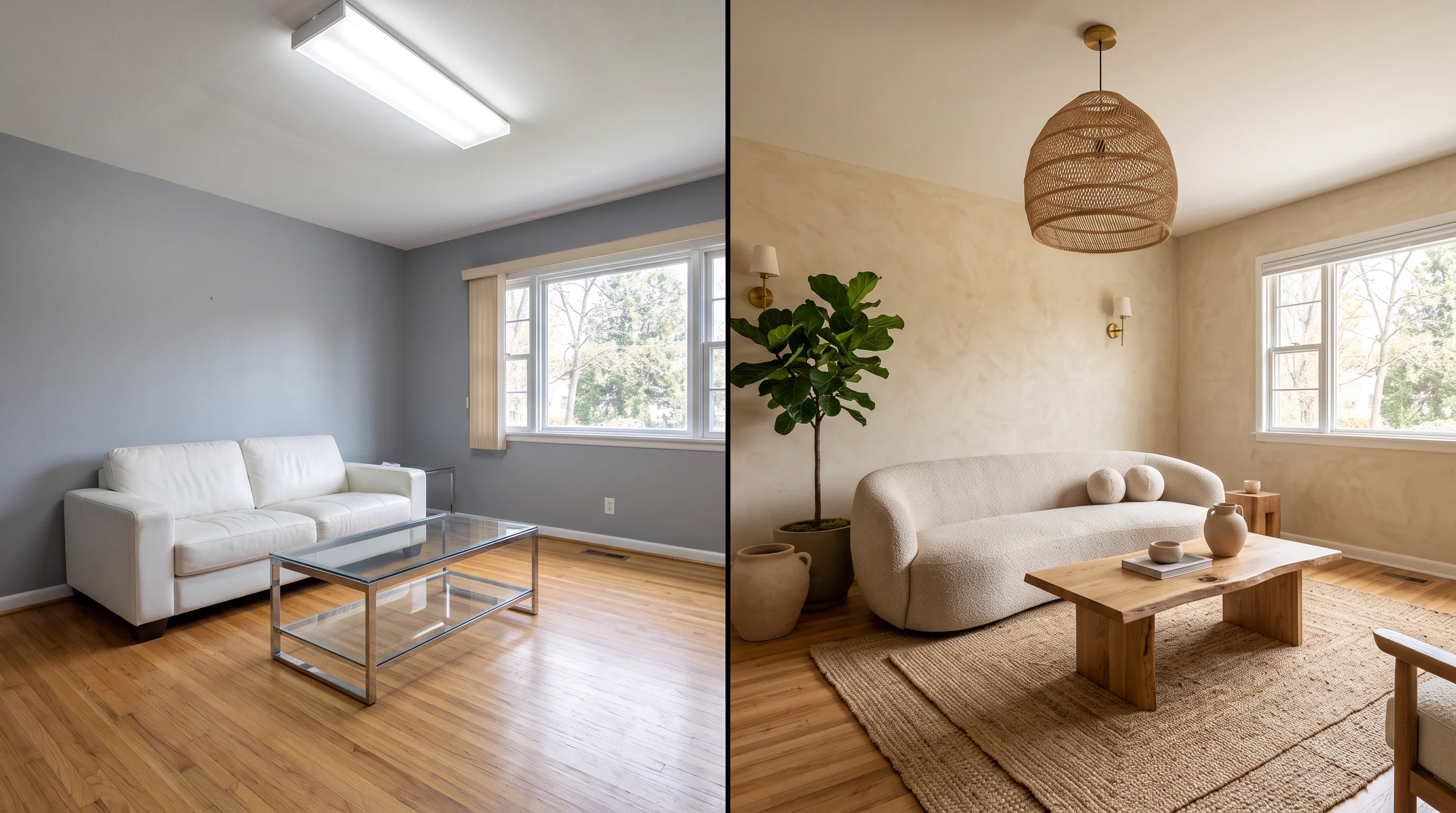
Upload a photo of your current space, choose a warm-neutral palette and natural materials, and see an organic modern transformation in seconds. Try it on your living room, bedroom, or kitchen and compare the before and after side by side.
FAQ
Is organic modern the same as warm minimalism?
No. Both use natural materials and warm palettes, but organic modern allows for more decor, bolder sculptural forms, and a wider color range (including rust, olive, and chocolate brown). Warm minimalism keeps to a tighter, cream-to-taupe palette with more negative space. See our full warm minimalism guide for the comparison.
What is the organic modern color palette?
A base of warm neutrals (sand, cream, oatmeal) covering about 70% of surfaces, grounded by 20% earthy mid-tones (rust, olive, chocolate, mushroom), and anchored by 10% matte black iron for definition. Avoid cool grays and polished metals.
Is organic modern going out of style?
The data says the opposite. NKBA puts organic/natural design at 58% among 634 surveyed professionals. 1stDibs reports organic modernism "held steady" into 2026 after reaching 31% in 2025. It is the rare style that both designers and homeowners agree on.
What furniture brands are known for organic modern?
Pottery Barn, West Elm, CB2, and Article carry accessible organic modern lines. At the higher end, look at RH (Restoration Hardware), Lulu and Georgia, and 1stDibs for vintage pieces. The key is choosing wood with visible grain, soft curves, and natural upholstery.
How do I start with organic modern on a budget?
Start with paint (lime wash or a warm neutral), swap one light fixture for a rattan or paper pendant, and layer a jute rug under your existing rug. These three moves cost under $200 total and immediately shift the room's feel. Then add unglazed ceramic vessels and linen throw pillows as budget allows.
Can I mix organic modern with other styles?
Absolutely. Organic modern pairs naturally with Japandi (shared love of natural materials and quiet forms), Mediterranean (stone and warmth overlap), and warm minimalism (same palette family). Avoid mixing with high-gloss or neon-heavy styles — the clash reads as unintentional.
Ready to Transform Your Space?
Try AI room redesign for free - no credit card required.
Start Designing FreeRelated reading
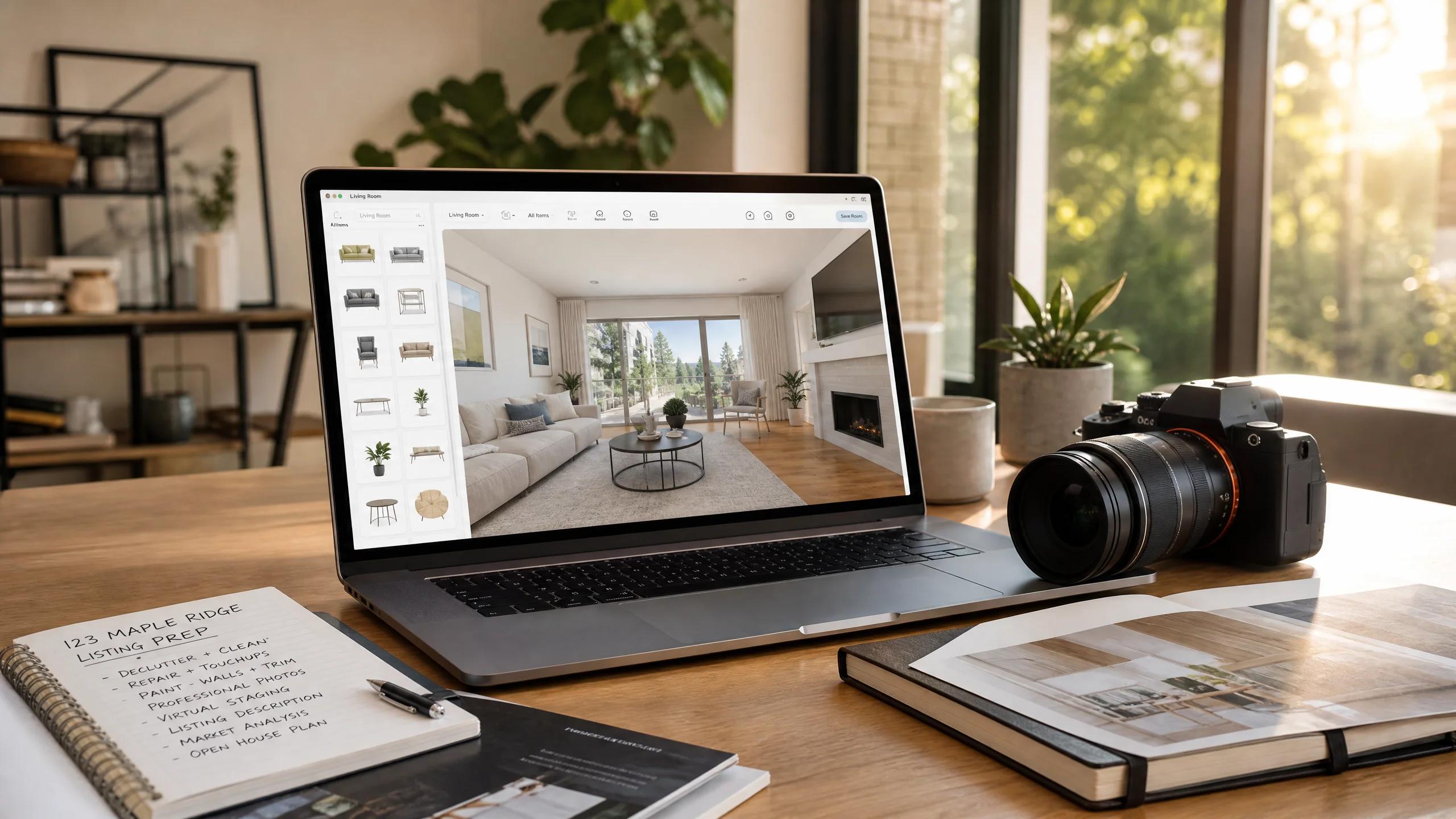
DIY Virtual Staging Software: How to Stage Listings Yourself in 2026 (Tools, Costs & Step-by-Step Guide)
Stop paying $24–$35 per photo to outsourcing agencies. Compare the top DIY virtual staging software in 2026, master the 5-step realtor staging workflow, and avoid costly MLS disclosure and perspective mistakes.
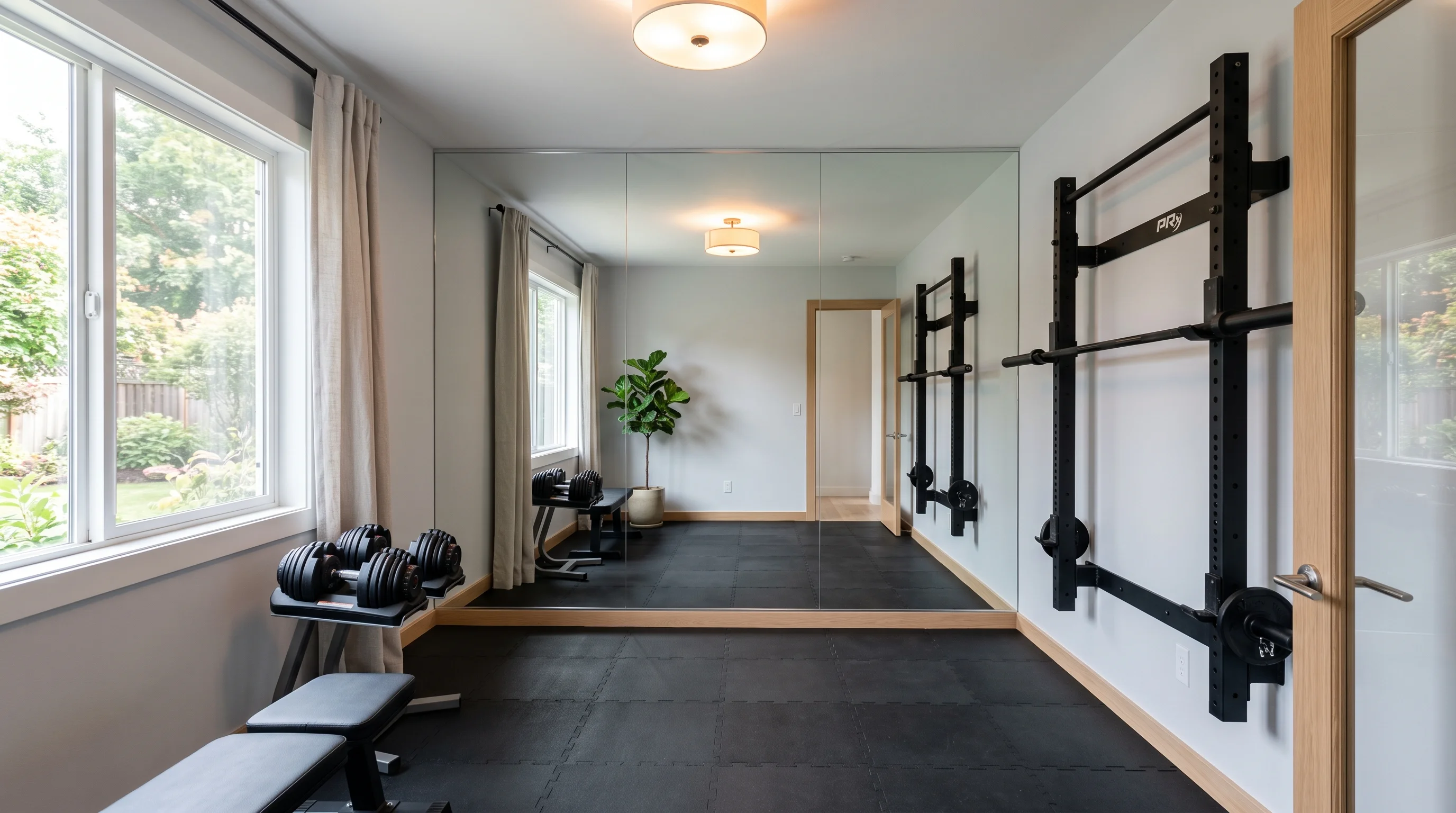
Small Home Gym Ideas 2026: How to Fit a Serious Gym in Under 100 Sq Ft
Discover clever small home gym layout ideas for 50 to 100 sq ft. Learn how to combine folding wall-mounted racks, selectorized dumbbells, vertical storage, and dual-purpose office zoning to build a studio-grade gym without sacrificing square footage.
Floor Virtual Staging: How to Replace Flooring in Real Estate Photos – Without Renovating (2026 Guide)
Discover how AI floor virtual staging replaces worn carpet and dated vinyl with luxury white oak hardwood in seconds. Recover 147% resale ROI while staying 100% MLS compliant.