The Real ROI of Virtual Staging: NAR Data, Not Vendor Math
Most 'virtual staging ROI' claims are vendor math with no source. This guide uses NAR's 2025 survey of 1,266 agents and real carrying-cost numbers to show what staging actually returns — and when it doesn't.
 Easy Room AI Team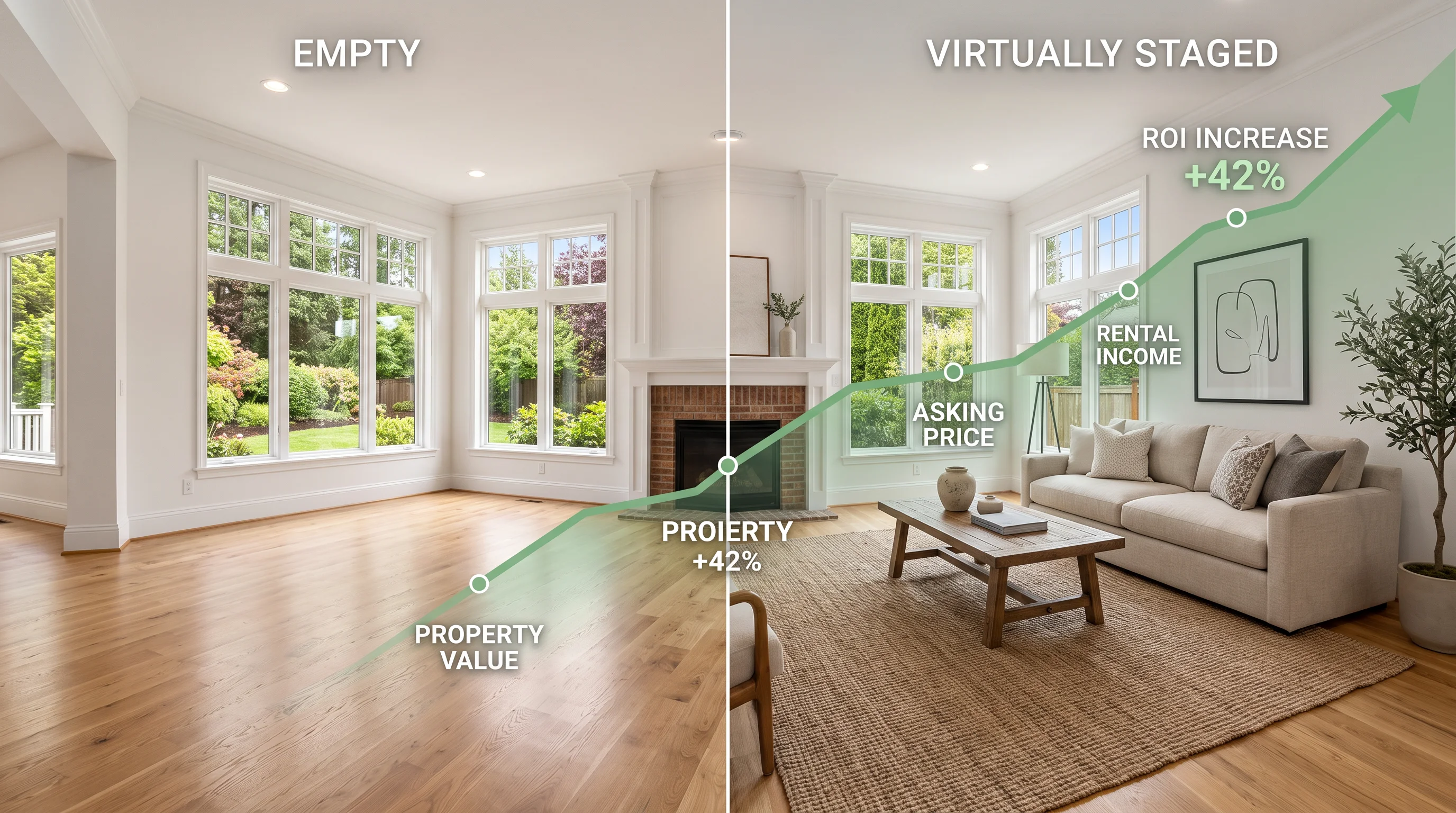
If you've searched "virtual staging ROI," you've seen the same headlines: "sells homes 73% faster," "ROI of 3,650%," "23% over asking."
Most of those numbers trace back to one staging vendor citing another staging vendor, with no methodology, no control group, and no traceable primary source. That's not ROI analysis — it's ad copy.
This guide does it differently. We use the National Association of Realtors' 2025 Profile of Home Staging (1,266 agents, ±2.75% margin of error), real carrying-cost math, and conservative defaults you can verify. The numbers are smaller than the ad copy — and far more useful, because you can actually plan around them.
Quick answer
Virtual staging ROI comes from two levers: faster sales (carrying-cost savings) and higher offers (price lift). NAR's 2025 data shows 49% of sellers' agents observed staging reduced time on market, and 29% reported a 1–10% price increase. On a $450,000 listing with AI staging at $12 per listing, even a 1% price lift ($4,500) plus 9 days of saved carrying costs ($1,350) returns $5,800+ on a $12 investment — a 48,000%+ ROI. The catch: these are probability-weighted outcomes, not guarantees. Run your own numbers →
The vendor math problem

Before we get to what the data actually says, let's address what it doesn't say.
You've probably seen these claims in virtual staging marketing:
- "Staged homes sell 73% faster"
- "Virtual staging delivers 3,650% ROI"
- "Homes sell for 23% over asking with staging"
Here's the problem: none of these trace back to a primary source with disclosed methodology.
The "73% faster" figure is the most common. It gets attributed to NAR, RESA, Zillow, or Redfin depending on which blog you're reading. But NAR's 2025 Profile of Home Staging doesn't contain that number. The actual NAR finding is: "49% of sellers' agents observed that staging reduced the time homes spent on the market." That's a survey observation from practicing agents, not a controlled experiment claiming a 73% reduction.
The inflated numbers typically have three problems:
- No control group. The seller who stages also prices competitively, hires a professional photographer, and markets aggressively. How much of the faster sale came from staging alone? These numbers don't isolate the variable.
- Selection bias. Agents who stage tend to be more experienced and invest more in marketing overall. Their listings would likely outperform even without staging.
- Circular sourcing. Vendor A cites Vendor B's blog, which cites Vendor C's press release, which cites "industry data" with no link. Google's AI Overview has even started citing "73% faster" as fact — because it scraped vendor blogs, not the NAR report.
This matters because you set seller expectations based on these numbers. If you promise 73% faster and the home sits for 40 days, you've damaged trust. If you promise "staging helps most buyers visualize the home, and roughly half of agents see faster sales," you've set an honest expectation you can deliver on.
We build virtual staging AI ourselves. We have every incentive to inflate these numbers. We choose not to — because honest data builds repeat business, and vendor math builds one-time sales.
What the NAR data actually says
The 2025 Profile of Home Staging is the industry's most credible staging study. NAR surveyed 49,806 active Realtors in February 2025, received 1,266 usable responses (95% confidence, ±2.75% margin of error). Here's what matters for ROI:
Price lift
| Finding | Percentage | Who reported it |
|---|---|---|
| Staging raised offers by 1–5% | 19% of sellers' agents | Sellers' agents |
| Staging raised offers by 6–10% | 10% of sellers' agents | Sellers' agents |
| Total: staging raised offers 1–10% | 29% of sellers' agents | Sellers' agents |
| Staging raised offers by 1–5% | 17% of buyers' agents | Buyers' agents |
| Staging had no impact on offers | 41% of buyers' agents | Buyers' agents |
Translation: about three in ten agents see a price increase from staging. That's real, but it's not universal. For seven in ten agents, staging didn't measurably move the price needle. The benefit for those sellers is more likely on the speed side.
Time on market
| Finding | Percentage |
|---|---|
| Staging slightly decreased DOM | 30% of sellers' agents |
| Staging greatly decreased DOM | 19% of sellers' agents |
| Total: staging decreased DOM | 49% of sellers' agents |
| No effect on DOM | 17% of sellers' agents |
| Staging increased DOM | 13% of sellers' agents |
Translation: roughly half of agents see faster sales from staging. The other half sees no change or (in a small minority) slower sales. Again — real but not guaranteed.
Buyer visualization
This is the most consistent finding: 83% of buyers' agents said staging made it easier for a buyer to visualize the property as their future home. This is the mechanism. Staging doesn't magically raise prices — it helps buyers emotionally connect with a space, which leads to faster decisions and sometimes stronger offers.
And here's the context that makes this a virtual staging argument: 97% of buyers start their home search online (NAR). They form their first impression from listing photos. Virtual staging targets exactly this moment — the scroll-stopping, click-generating, showing-requesting moment that happens on a screen, not in person.
What NAR doesn't tell us
The NAR data doesn't distinguish between physical and virtual staging in the outcome numbers. When an agent reports "staging reduced DOM," they may mean a $3,000 physical staging job or a $50 virtual staging package. The headline outcomes (price lift, DOM reduction) likely reflect a mix of both methods.
This is important for ROI calculations: the outcome data comes from staging broadly, but the cost inputs are radically different. That's where the ROI math gets interesting.
Stage a Vacant Room with AI in 30 Seconds
Upload an empty room photo to generate photorealistic, MLS-compliant staged furniture.
Supports JPG, PNG, WebP up to 10MB
The two ROI levers
Virtual staging ROI comes from two sources. Most vendor content conflates them. Let's separate them.
Lever 1: Carrying cost savings (faster sale)

Every day a home sits unsold costs the seller money. This is the carrying cost — mortgage interest, property taxes, insurance, utilities, HOA fees, and maintenance.
For a typical $450,000 home with a $320,000 mortgage at current rates:
| Cost component | Daily cost |
|---|---|
| Mortgage interest (6.5% on $320K) | ~$57 |
| Property taxes (1.1% of value) | ~$14 |
| Insurance (vacancy-adjusted) | ~$5 |
| Utilities (vacant minimum) | ~$8 |
| HOA / maintenance / lawn | ~$12 |
| Total daily carrying cost | ~$96 |
At $96/day, every week on market costs the seller roughly $670. A listing that sells 9 days faster saves **$864** in carrying costs alone.
For a $900,000 property, carrying costs climb to $150–$280/day — making the DOM reduction lever even more powerful at higher price points.
Lever 2: Price lift (higher offers)
NAR data: 29% of sellers' agents reported staging raised offers by 1–10%.
On a $450,000 home:
| Price lift | Dollar value |
|---|---|
| 1% | $4,500 |
| 3% | $13,500 |
| 5% | $22,500 |
| 10% | $45,000 |
Even the most conservative assumption — a 1% lift, which 19% of agents reported — produces $4,500 in additional value.
The combined math
Here's what the ROI looks like when both levers pull together on a $450,000 listing:
| Staging method | Cost | DOM saved | Carrying saved | Price lift (1%) | Net benefit | ROI |
|---|---|---|---|---|---|---|
| AI virtual staging | ~$12 | 9 days | $864 | $4,500 | $5,352 | 44,600% |
| Human virtual staging (8 images × $28) | $224 | 9 days | $864 | $4,500 | $5,140 | 2,295% |
| Physical staging | $2,500 | 9 days | $864 | $4,500 | $2,864 | 115% |
All three are positive ROI. But the magnitude of AI staging's return is in a different category — because the cost denominator is so small.
Important caveat: These are expected values, not guarantees. The 29% price-lift rate means roughly 3 in 10 listings see the full benefit. On a portfolio basis (multiple listings per year), the ROI math is very strong. On any single listing, the outcome is probabilistic.
Walk-through: Your $450,000 listing
Let's make this concrete with a single listing scenario. You have a vacant 3-bedroom single-family home listed at $450,000.
Without staging:
- DOM average for unstaged vacant homes in your market: ~40 days
- Carrying cost during that time: 40 × $96 = $3,840
- Sale price: $450,000 (assume list price)
With AI virtual staging (EasyRoomAI Premium at $49.90/month):
- Stage 8 rooms. Cost per listing: ~$12 (marginal cost within your monthly subscription)
- DOM with staging: ~31 days (9 days faster, based on NAR midpoint)
- Carrying cost: 31 × $96 = $2,976
- Carrying cost saved: $864
- If you're in the 29% who see a price lift: 1% = $4,500 additional
- Net benefit (conservative, with price lift): $864 + $4,500 − $12 = $5,352
- Net benefit (without price lift): $864 − $12 = $852
Even without the price lift — just the carrying-cost savings — you're making 71× your staging investment back.
For an agent running 4 listings/month:
| Human VS ($28/img) | AI VS (Premium $49.90/mo) | |
|---|---|---|
| Monthly staging cost | $896 | $49.90 |
| Annual staging cost | $10,752 | $598.80 |
| Annual savings (AI vs human) | — | $10,153 |
| Break-even on Premium subscription | — | 1.7 days into the month |
The subscription pays for itself before the second day of the month. Every image after that is effectively free.
Run these numbers with your own inputs: Our Virtual Staging ROI Calculator lets you adjust listing price, volume, carrying costs, and price lift assumptions — so you see the math for your specific market and workload.
ROI by price point
The ROI math shifts dramatically with listing price, because the price-lift lever scales while staging cost stays flat.
| Listing price | AI staging cost | 1% price lift | Carrying saved (9d) | Net benefit | ROI |
|---|---|---|---|---|---|
| $250,000 | ~$12 | $2,500 | $530 | $3,018 | 25,150% |
| $450,000 | ~$12 | $4,500 | $864 | $5,352 | 44,600% |
| $750,000 | ~$12 | $7,500 | $1,440 | $8,928 | 74,400% |
| $1,200,000 | ~$12 | $12,000 | $2,880 | $14,868 | 123,900% |
At higher price points, AI staging ROI becomes almost absurd — because a $12 input is generating five-figure returns. This is why virtual staging is one of the highest-leverage investments available for luxury listings.
The flip side: at the $150,000 starter-home tier, the 1% price lift is $1,500 and carrying costs are lower. The ROI is still strong (~12,500%), but the absolute dollar benefit is smaller. Stage these homes too — the math still works — but manage seller expectations proportionally.
When the ROI math doesn't hold
Honest ROI analysis means acknowledging when staging doesn't pay:
1. The home is already furnished and well-maintained. If buyers can already visualize the space, staging adds marginal value. Professional photography optimization is a better investment here.
2. The market is extremely hot. In a market where homes sell in 3 days with multiple offers regardless, the DOM reduction lever has no room to pull. Staging won't hurt, but the ROI conversation changes — you're spending on insurance rather than expecting returns.
3. The photos are terrible. Staging garbage in produces garbage out. A dark, blurry, distorted photo won't stage well with any tool. Fix the photography first — that's the higher-ROI investment. (Read our DIY Virtual Staging Software Guide and complete guide to virtual staging for camera setup and lighting tips.)
4. The listing is fundamentally mispriced. Staging doesn't fix pricing problems. A home listed $50,000 over market won't sell faster because you added a virtual sofa. Price it right, then stage it.
5. You skip disclosure. In California, AB 723 makes willful failure to disclose virtually staged images a violation of real estate law. CRMLS fines start at $250. If you're spending on staging but creating legal liability by not disclosing, the ROI calculation inverts. Always disclose. (Our MLS Disclosure Generator makes this automatic.)
How to actually calculate your ROI
The formula is straightforward:
Net Benefit = (Days Saved × Daily Carrying Cost) + (List Price × Price Lift %) − Staging Cost
ROI % = (Net Benefit ÷ Staging Cost) × 100
The hard part is choosing the right inputs. Here are conservative defaults based on NAR data and 2026 market conditions:
| Input | Conservative default | Source |
|---|---|---|
| Days saved | 9 | NAR: 49% of agents see DOM reduction; conservative midpoint |
| Daily carrying cost | $96–$150 | Based on $320K–$500K mortgage at ~6.5%, 1.1% tax rate |
| Price lift | 1% | NAR: 19% of agents see 1–5% lift; floor of the range |
| AI staging cost per listing | ~$12 | EasyRoomAI Premium: $49.90/mo ÷ 4 listings |
| Human staging cost per listing | $224 | 8 images × $28/image (BoxBrownie-class) |
| Physical staging cost | $2,500 | NAR median: $1,500 (pro service) + logistics |
These are intentionally conservative. If your market shows stronger staging effects, your actual ROI will be higher. That's a pleasant surprise — much better than promising 3,650% and delivering confusion.
Skip the spreadsheet: Our Virtual Staging ROI Calculator runs this math automatically. Plug in your numbers, see the comparison across AI / human / physical staging, and share the results with sellers.
The bottom line
Virtual staging ROI is real — but it's real in a specific, defensible way:
- The visualization effect is strong. 83% of buyers' agents confirm staging helps buyers see a property as home. This drives engagement, showings, and offers.
- The speed benefit is probable. About half of agents see faster sales. That translates to concrete carrying-cost savings.
- The price lift is possible. About a third of agents see 1–10% higher offers. On any single listing it's not guaranteed; across a portfolio it's statistically likely.
- The cost advantage of AI staging is decisive. When the input cost is $12 instead of $2,500, even modest outcomes produce extraordinary returns.
The honest pitch to sellers: "Staging helps most buyers visualize your home, which typically leads to faster sales and sometimes higher offers. AI staging costs about $12 for your listing, vs $2,500+ for physical staging. The expected return is strong, and the downside is essentially zero."
That's a pitch built on data, not vendor math. And it's the one your sellers will thank you for — whether the home sells in 5 days or 35.
Ready to stage your next listing? Try EasyRoomAI Virtual Staging — architecture-locked AI that keeps walls, windows, and floors honest. See pricing →
FAQ
What is the ROI of virtual staging? Virtual staging ROI depends on listing price, days on market saved, and whether staging drives a price lift. Using NAR's 2025 data with conservative assumptions (9 days saved, 1% price lift, $96/day carrying cost), AI virtual staging at ~$12/listing returns roughly $5,350 — a 44,600%+ ROI. The two ROI levers are carrying-cost savings (faster sale) and price lift (higher offers). Calculate your specific ROI →
Does virtual staging help sell a house? Yes. NAR's 2025 survey of 1,266 agents found that 83% of buyers' agents say staging helps buyers visualize a property as their future home, and 49% of sellers' agents observed staging reduced time on market. Virtual staging delivers this visualization benefit through listing photos — where 97% of buyers start their search. It doesn't guarantee a faster sale on any single listing, but across a portfolio of listings, the probability-weighted benefit is strong.
Is the "73% faster" claim true? No traceable primary source supports it. NAR's 2025 Profile of Home Staging does not contain that figure. The actual finding is "49% of sellers' agents observed staging reduced time on market." The "73%" number originates from staging vendor blogs citing each other without methodology or control groups. Plan around the NAR data, not the ad copy.
How much does virtual staging cost vs physical staging? AI virtual staging: ~$1–$15 per image ($12–$75 per listing). Human virtual staging: $24–$100 per image ($192–$800 per listing). Physical staging: $2,000–$10,000+ per listing. For detailed vendor math, subscription traps, and wholesale margins, see our 2026 Virtual Staging Cost Breakdown and our benchmark of the Best AI Virtual Staging Tools.
When is virtual staging NOT worth it? When the home is already well-furnished, when the market is so hot that homes sell in days regardless, when the listing photos are too low-quality for AI to produce good results (fix photography first), or when the listing is fundamentally overpriced. Staging fixes visualization — it doesn't fix pricing or marketing strategy problems.
What data should I show sellers about staging ROI? Lead with the NAR numbers: 83% of buyers' agents say staging helps visualization, 49% of sellers' agents see faster sales, 29% see 1–10% higher offers. Then show the carrying-cost math for their specific property using our ROI Calculator. Sellers respond to "staging your home costs $12 and could save you $800+ in carrying costs" better than inflated percentages.
Ready to Stage a Listing?
Upload a vacant room photo and generate listing-ready furniture — sign in with credits to generate.
Stage a ListingRelated reading
Virtual Staging Cost in 2026: What You'll Actually Pay (AI, 360 Tours & Hidden Fees)
AI staging costs $0.20–$5 per image. 360° virtual tours cost $1.99–$400. Human editing runs $16–$75, and physical staging hits $2,000–$12,000+. Discover the true pricing breakdown, hidden credit traps, MLS fine risks, and real photographer margins.

DIY Virtual Staging Software: How to Stage Listings Yourself in 2026 (Tools, Costs & Step-by-Step Guide)
Stop paying $24–$35 per photo to outsourcing agencies. Compare the top DIY virtual staging software in 2026, master the 5-step realtor staging workflow, and avoid costly MLS disclosure and perspective mistakes.

360 Virtual Staging: Complete Real Estate Guide (2026)
Master 360 virtual staging for real estate in 2026 — camera setups, AI panoramic furnishing, seamless 2:1 exports to Matterport & Kuula, and MLS compliance.